Tag Archives: Egypt

#Jan25 – One Year Later, Egypt Is Still Struggling for Media Freedom

I’ll never forget it. I received a text message and raced over to meet a friend at a bar on a dark street in the Hamra district of Beirut. The place was packed with young and old alike, their faces stretched with emotion as they experienced a sensation unfamiliar to much of the Arab World–that of hope. A massive screen had been set up in a corner as if we were going to watch a World Cup match. Indeed, the anticipation felt much like that of the start of an exciting sporting event, and the subsequent deflation of spirit that followed was as disappointing as a defeat. But this was far more important than any football game. This was freedom at stake.

Hosni Mubarak did not resign that night as much of the world had expected, but his defiance was only to last another day. The man who had ruled Egypt for three decades, to whom we had referred to as Pharaoh Mubarak, finally gave in to the demands of people who only wanted the most basic of things in life: freedom, dignity, a voice.

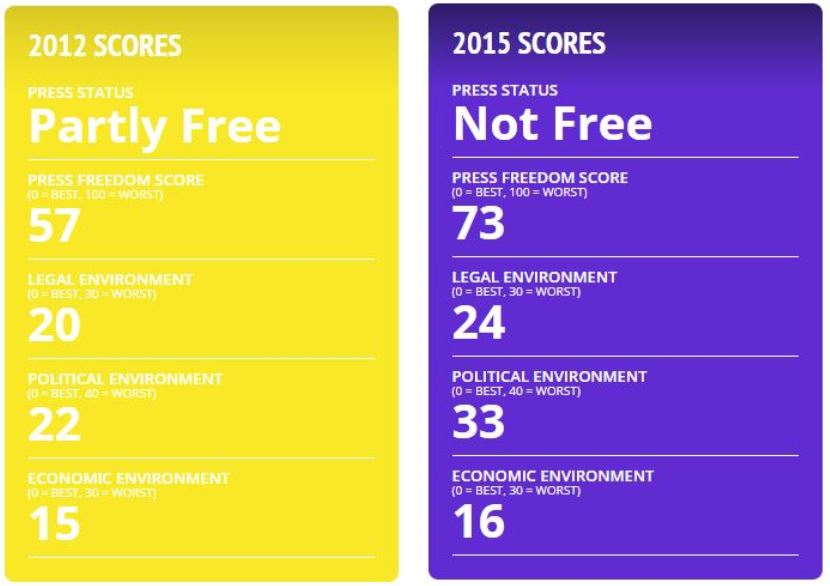
Tunisia may have sparked what has come to be known as the Arab Spring, but it was Egypt that burned images of revolution into our minds. Events that led to that night began a year ago today, a day when hope burst forth from the souls of those who had been shackled by oppression for most or all of their existence. But the year has been wrought with setbacks, worry, crackdowns, and death. The media environment has been just one of the many victims of the oppressive tactics of the ruling Supreme Council of the Allied Forces (SCAF) that took the promises of the revolution and kept them for itself.

On the day after Mubarak resigned, Egyptian state television broadcasters apologized on air for lying to the people in their coverage of the revolution, blaming the state for ordering them to report a pro-state narrative, even showing an old video of an empty Tahrir Square. The position of information minister was eliminated in late February 2011, making Egypt, Lebanon, and Qatar the only countries in the Arab world without such a position. Soon after, however, state media returned to the role of propaganda machine, pushing a narrative that further protests were part of a foreign plot, a theme they would continue to promulgate as the SCAF moved to consolidate its power.  The National Military Media Committee was created as SCAF’s propaganda arm to counteract what it called “biased coverage” against the military, and the post of information minister was reestablished.  Protesters were demonized and portrayed as traitors to the revolution, and democracy activists became agents of foreign interference.

In this atmosphere, Maikel Nabil Sanad, an atheist who was supportive of Israel, was arrested in a calculated move by the military to set an example for other activists. He had written a post on his blog titled “The army and people wasn’t ever one hand,” which enumerated the military’s acts of oppression. “In fact, the revolution has so far managed to get rid of the dictator but not the dictatorship,” he wrote at a time when the military was viewed as heroic for its role in overthrowing Mubarak.  On March 28, 2011, he was arrested on charges of “insulting the military.” Despite undertaking a hunger strike in protest of the unlawful detention, Nabil did not receive much support because of his views, and in the international community, his arrest went virtually unnoticed.

Nowhere were the effects of state media propaganda more devastating than at the Maspero media complex in Cairo, when Coptic Christian protesters were portrayed as aggressors, inciting violence that led to the deaths of 27 civilians.

Citizen journalism and social media came to define the movement that the world witnessed in real time, and it is what has kept the spirit of revolution alive. While the Internet may not have been the reason for the movement’s birth, there is no denying it had a major influence on Mubarak’s ouster and the continuing protests. Alla Abdel Fattah, the activist blogger who was arrested last autumn and who was instrumental in rallying support for Nabil, has played a big role in awakening the world to the oppressive tactics of the SCAF. Wael Ghonim, founder of the We Are All Khaled Said Facebook page, and Wael Abbas, another well-known blogger, were both detained at various times. Egyptian-American journalist Mona Eltahawy’s arms were broken when she was detained late last year.

The work of Egyptian citizen journalists can be found on the Mosireen YouTube channel. Mosireen is a media collective of filmmakers and citizen journalists that has become one of the most popular non-profit YouTube channels in the world. It has published videos from the revolution and was instrumental in showing the world the truth about the Maspero massacre. Sites like Mosireen show that state media can no longer hide the truth from the world.

The pressure that citizen journalism has put on state media is showing some results. Last week, employees at the state-owned Nile News Channel began a sit-in to demand an immediate end to censorship and to push for reforms in the state media sector. The protest was sparked by a ban on broadcasting the documentary Tahrir Square, which shows the military’s brutal treatment of the January 25 protesters. It is worth mentioning that Nile News Channel is located in the Maspero building where the Coptic protesters were murdered last October.

The SCAF has made some concessions in the days leading up to today’s anniversary. Nabil has been released, along with nearly 2,000 other prisoners. The Supreme Press Council is currently drafting proposals to amend freedom of expression laws and plans to form a committee of professional journalists to help develop mechanisms to “free the media from government domination.” However, many activists believe these moves have been designed to ease tension and are not long-term changes.

Today, hundreds of thousands of Egyptians gathered at Tahrir demanding the same human rights they wanted a year ago. They have sipped from the cup of liberty and seem determined not to give up until freedom is theirs.


Other resources:

For Egypt’s State Media, the Revolution Has Yet to Arrive – Freedom House

National Coalition for Media Freedom

Watch “The Egyptian Revolution,” a multimedia documentary produced by TrustMedia, the media development wing of the Thomson Reuters Foundation (TRF).

Nile News Channel’s sit-in:

Sparking Media Development in Tunisia and Egypt

The discovery of fire changed the world. It allowed human beings to move to colder regions, cook food to prevent disease, and protected them from wild animals, giving the species a kind of primitive freedom.

On December 17, 2010, fire changed the world again when a frustrated vegetable vendor ignited himself and secured a place in world history books. He was the spark that set the flame that has come to be known as the “Arab Spring.”

The information flow that reached the world during these events is well-documented.  Some have referred to a “Facebook Revolution.” Now that the dictators in Tunisia and Egypt have fallen, media outlets in both countries have proliferated. Improving the media environment is vital to establishing stable democracies in these countries.

Asma Ghribi, Dina Sadek, and Magdy Samaan are young journalists who are part of these new media environments. They have just completed fellowships with World Affairs Institute and offered their advice on how international media development organizations can help journalists in Tunisia and Egypt.

Asma Ghribi works for Tunisia Live (http://www.tunisia-live.net), an English-language news website that reports on Tunisia.  The site seeks to have Tunisian reporters provide news about the country to the English-speaking world rather than leaving the task to foreign reporters. Asma reports on Tunisian politics, a topic that was taboo under the Ben Ali regime.  She would like to see the country address the dearth of quality political reporting that could be remedied with training on how to interview political leaders, investigative reporting, and how to report on politics objectively.

The greatest threat to Tunisia Live is not censorship or harassment, but sustainability of the site.  Demand is not high within Tunisia for news in English, which makes advertising sales difficult. Tunisia Live is one of many news outlets that faces the issue of sustainability, an issue with which the fellows would like the international community to help.

Across the Sahara, Dina Sadek works as a freelance journalist in Egypt.  The challenges facing journalists in post-Mubarak Egypt have been enormous, as the harassment, arrest, and detention of journalists and bloggers is commonplace.  Notable cases are Alaa Abdel Fattah, a well-known blogger and activist, Maikel Nabil, who has been on a hunger strike since August, and most recently, Egyptian-American journalist Mona Eltahawy, who suffered two broken arms at the hands of authorities.

Egyptian journalists face numerous challenges, but freelancers have additional problems.  They are not allowed to be members of the Journalists Syndicate, are poorly paid, and receive none of the benefits journalists in the syndicate enjoy.  There is not even a word for “freelance” in the Arabic language.

Egyptian journalist Magdy Samaan of Al-Shorouk Al-Jadid (http://www.shorouknews.com) says local media development is vital to the establishment of strong media institutions.  Egyptian media is centralized in Cairo, and a dearth of trustworthy local news leaves many without the ability to learn about local issues.  Training for local journalists, editors, and managers, especially in radio, is needed.

How can the international donor community help?  For starters, journalists in Tunisia and Egypt need training on the role of media in a democratic society.  Training can put journalists on the path to professionalism and its components of ethics and objectivity.   The three young journalists agree that financial and administrative training, tech training for journalists and media managers, and capacity building for media NGOs and associations are also important.

So what are international media development organizations doing in Egypt and Tunisia?  Some examples:

  • Institute on War and Peace Reporting (IWPR) provides safety and identity protection training.
  • International Center for Journalists (ICFJ) conducts training for local journalists in places like Minia and Alexandria, supports citizen journalists, and has two Knight Fellows working on investigative reporting and Hacks/Hackers projects.  The organization also conducts “town hall” trainings but finds it challenging to identify who needs this training.
  • Internews conducts capacity building training for media-related NGOs.
  • Reporters Without Borders lends helmets and safety equipment, but the costs to ship from Paris are limiting.
  • The International Research and Exchange Board’s (IREX) Media Development Program (MDP) works with media outlets and training institutes to improve the professionalism and sustainability of Egypt’s media sector.  MDP offers training, consulting, and equipment assistance to Egyptian print and electronic media as well as to universities and other media support organizations.
  • The newly launched Journalism Foundation is conducting a media training course for Tunisian journalists.
  • For information about NED programs in media development, click here

These programs are working toward the ultimate goal of the so-called Arab Spring: lighting the flame of liberty.  But there is much work to be done.  Fortunately, passionate young journalists like Asma, Dina, and Magdy are there to carry the torch.